If you’ve seen S/U in a text message and wondered what it means the most common meaning is Swipe Up. People often use it on social media platforms like Instagram Snapchat and TikTok to encourage others to open a link view content or interact with a post.
Many people search for this term because internet slang changes quickly and abbreviations often have different meanings depending on the platform.
Whether you spotted S/U in a chat story caption or direct message, understanding its meaning can help you follow online conversations more easily.
In this guide you’ll learn what S/U means where it’s used how people reply to it and how it compares to other common texting abbreviations.
S/U Meaning in Text
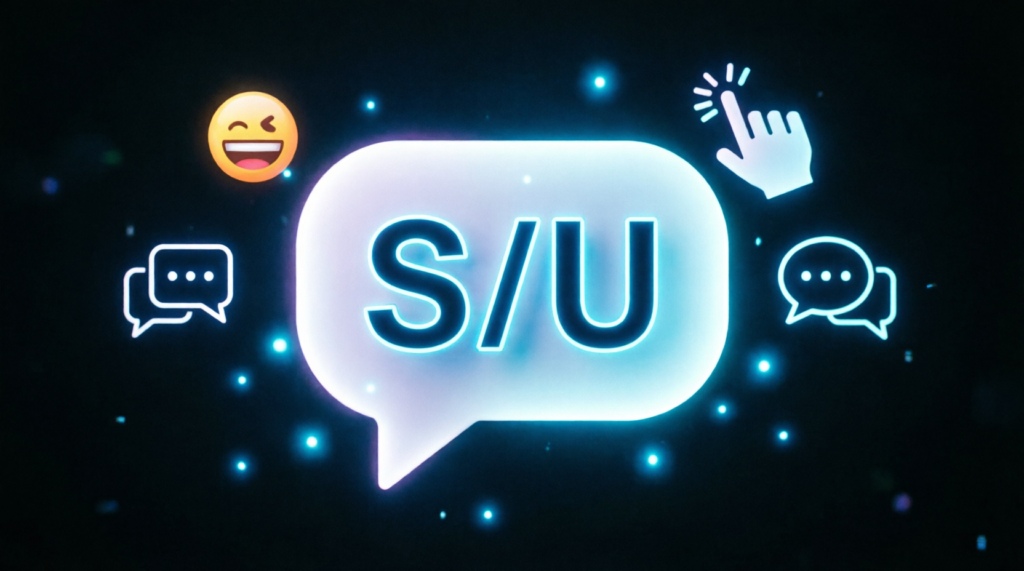
The abbreviation S/U most commonly stands for Swipe Up.
It became popular on social media, especially when users wanted others to access a link attached to a story or post.
In everyday online conversations, S/U is often used as a quick call to action. Instead of typing “swipe up to see more” or “swipe up for details,” people simply write “S/U.”
Is S/U Slang, an Acronym, or an Abbreviation?
S/U is generally considered an abbreviation.
It shortens the phrase “Swipe Up” into two letters separated by a slash.
Although it isn’t traditional slang like “lit” or “sus,” it functions similarly because it is part of internet culture and online communication.
What Does It Mean in Everyday Chat?
In casual conversations, S/U usually means:
- Swipe up for more information
- Open a link
- View additional content
- Check out a recommendation
- Visit a page or website
The exact meaning depends on the context, but it almost always involves directing someone to additional content.
Where People Use S/U
S/U appears across several social media platforms and messaging apps.
TikTok
On TikTok, users may use S/U in captions, comments, or promotional content.
Although TikTok’s features change over time, the abbreviation is still widely recognized as meaning “Swipe Up” or “check the link.”
Snapchat
Snapchat users commonly use S/U in stories.
Someone might post:
“S/U for the full video.”
This tells viewers to access additional content.
Instagram helped popularize the term.
Influencers, creators, and businesses frequently used S/U when directing followers to products, blogs, videos, or promotions.
In WhatsApp conversations, friends sometimes use S/U when sharing content.
For example:
“S/U and check the photos.”
SMS Text Messages
While less common in traditional texting, some people still use S/U when sharing links or recommending content.
The meaning remains the same: take action and view something.
Real Chat Examples
Here are 10 realistic examples showing how people use S/U in conversations.
Example 1
A: Did you see my new post?
B: Not yet.
A: S/U and check it out.
Example 2
A: Where’s the discount code?
B: It’s in my story.
A: Oh, got it.
Example 3
A: Want the full tutorial?
B: Yes.
A: S/U for the link.
Example 4
A: I uploaded all the vacation photos.
B: Really?
A: Yep, S/U to see them.
Example 5
A: How do I join the event?
B: S/U on my story.
A: Thanks.
Example 6
A: Is the giveaway still open?
B: Yes.
A: Great.
B: S/U and enter.
Example 7
A: I found a great restaurant.
B: Which one?
A: S/U for details.
Example 8
A: Can I watch the full clip?
B: Sure.
A: Where?
B: S/U from the story.
Example 9
A: What’s everyone talking about?
B: New product launch.
A: Where can I see it?
B: S/U.
Example 10
A: Do you have the website?
B: Yes.
A: Send it.
B: Just S/U on my post.
How to Reply When Someone Says “S/U”
Your response depends on the conversation.
Funny Replies
- Only if there’s pizza involved.
- I’m swiping faster than ever.
- Consider it swiped.
- Mission accepted.
Casual Replies
- Okay, checking now.
- Got it.
- I’ll take a look.
- Thanks for sharing.
Friendly Replies
- Awesome, I’ll check it out.
- Thanks for letting me know.
- Sounds good.
- Appreciate it.
Neutral Replies
- Understood.
- I’ll view it shortly.
- Thanks.
- Noted.
Is S/U Rude or Offensive?
No, S/U is generally not rude or offensive.
It is simply a shortcut used in online communication.
Is It Safe to Use?
Yes.
The abbreviation itself is harmless and commonly used across social media platforms.
Is It Appropriate at School?
Usually yes.
Students often use internet abbreviations in casual conversations with friends.
Is It Appropriate at Work?
In professional communication, it may be better to write the full phrase rather than using abbreviations.
For example:
“Please view the attached link.”
This sounds more professional than “S/U.”
Who Uses This Term?
S/U is mostly used by people who spend time on social media.
Gen Z Usage
Gen Z users are among the most frequent users of internet abbreviations.
Many younger users understand S/U immediately because they encounter it regularly online.
Common Age Groups
The term is most common among:
- Teenagers
- Young adults
- Social media creators
- Influencers
- Digital marketers
Common Platforms
You’ll most often see S/U on:
- Snapchat
- TikTok
- Messenger
How Often Does It Appear Online?
The popularity of S/U has changed over time as social media features evolved.
However, many users still recognize and understand it instantly.
Origin of the Term
The origin of S/U is tied closely to social media culture.
As platforms introduced story features and interactive links, users needed a quick way to tell followers what action to take.
Instead of repeatedly typing “Swipe Up,” people shortened it to S/U.
Internet Culture Influence
Internet users naturally create abbreviations to save time.
Just like LOL, BRB, and IDK, S/U became a convenient shortcut.
Is the Origin Clear?
Yes, relatively.
Unlike some slang terms with uncertain histories, S/U is widely understood to have originated from the phrase “Swipe Up” used on social media stories.
Comparison Table
| Term | Meaning | Type | Usage | Popularity |
|---|---|---|---|---|
| S/U | Swipe Up | Abbreviation | Directing users to content | Medium |
| IDK | I Don’t Know | Acronym | Expressing uncertainty | Very High |
| IDC | I Don’t Care | Acronym | Showing indifference | High |
| IMO | In My Opinion | Acronym | Sharing opinions | High |
| BRB | Be Right Back | Acronym | Temporary absence | High |
Real-World Usage Example
Imagine a content creator launches a new online course.
They upload a story promoting the course and write:
“New course is live! S/U for enrollment details.”
Followers who see the story understand that they should open the provided link to learn more.
This is one of the most common real-world uses of the abbreviation
Different Meanings of S/U in Text
Although S/U most commonly means “Swipe Up,” it can occasionally have different meanings depending on the conversation and platform.
For example, in some online communities, S/U may be used as shorthand for:
- Speak Up
- Shut Up
- See You
- Swipe Up
The intended meaning usually becomes clear from the context. When discussing social media stories, it almost always refers to “Swipe Up.” In private conversations, however, users may use it differently.
Because internet slang evolves quickly, it’s always a good idea to look at the surrounding message before assuming its meaning.
Why People Use S/U Instead of Writing the Full Phrase
Texting culture is built around speed and convenience.
People often shorten common phrases to save time while typing. S/U is much faster to write than “Swipe Up,” especially when responding to multiple messages or posting social media stories.
Some reasons people use S/U include:
- Faster communication
- Less typing
- Familiarity among social media users
- Character-saving in captions and posts
- Following online trends
Short abbreviations like S/U have become a normal part of digital communication.
How S/U Changed With Social Media Trends
The popularity of S/U grew rapidly during the rise of social media story features.
When platforms introduced stories with clickable links, creators needed a quick way to tell followers how to access additional content.
As a result, phrases like:
- Swipe Up for details
- Swipe Up for more
- Swipe Up to shop
- Swipe Up to watch
were shortened to simply S/U.
Even as platform features continue to change, many users still recognize the abbreviation because it became part of internet culture.
Common Situations Where You Might See S/U
You may encounter S/U in several everyday online situations.
Product Promotions
Businesses often use S/U to direct customers to a product page or online store.
Example:
“New collection available now. S/U to shop.”
Video Content
Creators may encourage viewers to watch a full video.
Example:
“S/U for the complete tutorial.”
Event Announcements
People promoting events often use S/U to provide registration links.
Example:
“Tickets are available. S/U to reserve your spot.”
Blog or Article Sharing
Writers and publishers may use S/U when sharing articles.
Example:
“Read the full story. S/U for the article.”
Signs That S/U Means “Swipe Up”
Sometimes abbreviations can be confusing.
Here are clues that indicate S/U means “Swipe Up”:
- A link is attached.
- The message mentions a story.
- Someone is promoting content.
- The post encourages an action.
- The conversation involves social media.
For example:
“New giveaway! S/U now.”
In this case, “Swipe Up” is the most logical interpretation.
When S/U Might Cause Confusion
Not everyone is familiar with internet abbreviations.
Older users or people who rarely use social media may not immediately understand what S/U means.
This can create confusion in conversations, especially when there is no clear context.
Instead of writing:
“S/U for details.”
You could write:
“Swipe up for details.”
Using the full phrase can make your message easier for everyone to understand.
Similar Internet Slang Terms Related to S/U
If you’re learning online slang, you’ll probably encounter other abbreviations that serve a similar purpose.
DM
Means “Direct Message.”
Example:
“DM me for more information.”
Link in Bio
Used when creators want followers to visit a link listed in their profile.
Example:
“Link in bio for details.”
FYI
Means “For Your Information.”
Example:
“FYI, the event starts at 7 PM.”
BTW
Means “By The Way.”
Example:
“BTW, I already signed up.”
Learning these common abbreviations can make online communication much easier.
Should Parents Know What S/U Means?
Yes.
Parents who monitor their children’s online activity may come across abbreviations like S/U on social media.
Fortunately, S/U is generally harmless and is usually related to viewing content, promotions, videos, or links.
Unlike some internet slang terms that may carry hidden meanings, S/U is typically straightforward and easy to understand once you know what it stands for.
How Brands and Influencers Use S/U
Businesses and influencers often rely on quick calls to action.
S/U became popular because it encourages users to interact immediately.
Common marketing uses include:
- Visiting a website
- Buying a product
- Watching a video
- Reading an article
- Joining a newsletter
- Entering a giveaway
Because it is short and recognizable, S/U became a favorite phrase among social media marketers.
Mistakes People Make When Using S/U
Some users assume everyone understands internet abbreviations.
This can sometimes lead to misunderstandings.
Common mistakes include:
- Using S/U in formal emails
- Using it with people unfamiliar with social media
- Assuming it has only one meaning
- Using it without providing a link or context
To avoid confusion, make sure the audience understands the abbreviation and the intended action.
Is S/U Still Popular Today?
While internet trends change constantly, S/U remains recognizable among social media users.
Its popularity may not be as high as universal abbreviations like LOL or IDK, but millions of users still understand what it means.
The term continues to appear in:
- Social media captions
- Influencer posts
- Promotional content
- Group chats
- Messaging apps
As long as people share content online, abbreviations like S/U are likely to remain part of internet communication.
Quick Summary of S/U Meaning
Here’s a simple recap:
- S/U usually means Swipe Up.
- It is an abbreviation commonly used online.
- It appears most often on social media platforms.
- It encourages users to view additional content.
- It is generally not rude or offensive.
- It is best used in casual online communication.
- Context is important because it can occasionally have other meanings.
S/U Meaning in Online Dating Conversations
S/U can sometimes appear in dating apps, social media messages, or private chats. In these situations, the meaning depends heavily on context.
If someone sends “S/U” alongside a profile link, photo collection, or story, they are usually asking you to view additional content.
Because abbreviations can have multiple meanings, it’s always best to consider the rest of the conversation before responding.
Example
A: I uploaded some new pictures.
B: Where can I see them?
A: S/U on my story.
In this example, S/U clearly means “Swipe Up.”
Why Context Matters When Interpreting S/U
One reason internet slang can be confusing is that the same abbreviation may represent different phrases.
That’s why context is often more important than the letters themselves.
Before deciding what S/U means, ask yourself:
- Is this a social media conversation?
- Is there a link attached?
- Is someone promoting content?
- Is the discussion happening in a private chat?
The answers usually reveal the intended meaning.
How New Users Learn Terms Like S/U
Many people don’t learn internet slang from dictionaries. Instead, they pick it up naturally through daily online interactions.
A user might see S/U several times in stories, captions, and messages before finally understanding what it means.
Common ways people learn internet abbreviations include:
- Watching social media content
- Reading comments
- Joining group chats
- Following influencers
- Asking friends
Over time, terms like S/U become easier to recognize.
S/U in Group Chats
Group chats often move quickly, so participants use abbreviations to communicate faster.
S/U may appear when someone wants the entire group to view a shared link, event page, or announcement.
Example
A: I posted the party details.
B: Where?
A: S/U for the location.
This saves time compared to typing a longer explanation.
S/U in Business and Marketing Messages
Marketing teams often use short phrases that encourage immediate action.
S/U became useful because it creates a simple instruction that many users instantly understand.
Businesses may use it to:
- Promote products
- Announce sales
- Share blog posts
- Collect signups
- Increase website traffic
Because it’s brief and direct, it works well in fast-paced social media environments.
Can S/U Improve Engagement?
From a social media perspective, yes.
Short calls to action often encourage users to interact with content more quickly.
When followers see S/U, they immediately know that additional information is available.
This can increase:
- Link clicks
- Story interactions
- Website visits
- Product views
- Content engagement
That’s one reason the abbreviation became popular among creators and brands.
Regional Differences in S/U Usage
Internet slang doesn’t always have the same popularity everywhere.
In some countries, S/U is widely recognized because social media usage is high.
In other regions, users may prefer writing the full phrase instead of the abbreviation.
However, because platforms like TikTok, Instagram, and Snapchat are global, many online users understand S/U regardless of location.
How S/U Differs From Traditional Texting Language
Traditional texting abbreviations often focus on replacing entire sentences.
Examples include:
- LOL (Laugh Out Loud)
- BRB (Be Right Back)
- TTYL (Talk To You Later)
S/U is slightly different because it usually functions as an instruction rather than an emotional reaction or statement.
Instead of expressing a feeling, it tells the reader to take a specific action.
Common Misunderstandings About S/U
People occasionally assume S/U has a negative meaning because they confuse it with other abbreviations.
In reality, most uses of S/U are neutral and practical.
Some misunderstandings include:
- Thinking it is an insult
- Assuming it is secret slang
- Believing it has only one meaning
- Interpreting it without context
A quick look at the surrounding conversation usually clears up any confusion.
Should You Use S/U in Professional Communication?
Generally, no.
Professional emails, workplace chats, and business documents are usually clearer when written in full.
Instead of:
“S/U for more information.”
You could write:
“Please view the attached link for more information.”
The full sentence appears more polished and professional.
How S/U Reflects Modern Internet Communication
The rise of abbreviations like S/U shows how online communication continues to evolve.
People want messages that are:
- Fast
- Easy to read
- Mobile-friendly
- Simple to type
As digital communication becomes more common, abbreviations help users exchange information efficiently without lengthy explanations.
Benefits of Understanding Internet Slang
Learning terms like S/U offers several advantages.
You can:
- Understand conversations more easily
- Follow social media trends
- Avoid communication mistakes
- Recognize online marketing language
- Participate confidently in digital discussions
Even if you don’t personally use internet slang, knowing its meaning helps you navigate online spaces more effectively.
What To Do If You’re Unsure About S/U
If you encounter S/U and the meaning isn’t obvious, don’t guess.
You can:
- Check the surrounding messages
- Look for attached links
- Review the platform where it appears
- Ask the sender for clarification
Most people are happy to explain what they mean, especially when abbreviations have multiple interpretations.
Future of Abbreviations Like S/U
Internet language changes constantly.
Some abbreviations disappear after a few years, while others become permanent parts of online culture.
S/U has remained recognizable because it is simple, useful, and connected to common social media behavior.
Even as platforms introduce new features, users will likely continue creating shortcuts that make communication faster and more convenient.
Related Texting Abbreviations Worth Knowing
If you’re researching S/U, you may also come across these popular abbreviations:
| Abbreviation | Meaning |
|---|---|
| LOL | Laugh Out Loud |
| TBH | To Be Honest |
| SMH | Shaking My Head |
| NGL | Not Gonna Lie |
| TTYL | Talk To You Later |
| ROFL | Rolling On the Floor Laughing |
| IKR | I Know, Right? |
| FOMO | Fear Of Missing Out |
| BFF | Best Friends Forever |
| WYD | What Are You Doing? |
Learning these common abbreviations can make texting, social media, and online conversations much easier to understand.
Expert Tip for Understanding Text Abbreviations
Whenever you encounter an unfamiliar abbreviation, focus on the context before searching for a definition.
The same letters can have different meanings depending on:
- The platform
- The audience
- The conversation topic
- The user’s intention
Frequently Asked Questions
What does S/U mean in text messages?
S/U usually means “Swipe Up.” It directs someone to additional content or a link.
What does S/U mean on TikTok?
On TikTok, S/U generally means “Swipe Up” or check a linked resource, depending on the context.
Is S/U slang?
It is more accurately described as an abbreviation, though many people consider it part of internet slang culture.
Is S/U rude or offensive?
No. It is a neutral abbreviation and is not considered offensive.
How should you reply to S/U?
You can respond with phrases like “Got it,” “Checking now,” “Thanks,” or “I’ll take a look.”
Conclusion:
S/U most commonly means Swipe Up. It is a popular internet abbreviation used to direct people toward additional content links promotions videos or information.
You’ll most often encounter it on Instagram Snapchat TikTok WhatsApp and other social platforms.
The term is generally safe friendly and easy to use in casual online conversations. However in formal or professional settings writing the full phrase is usually the better choice.
Understanding abbreviations like S/U makes it easier to navigate modern digital communication and keep up with online conversations.
Discover more post:
| https://meanguid.com/oops-meaning/ |
| https://meanguid.com/wsp-mean/ |
| https://meanguid.com/what-does-sg-mean-in-text/ |