ONG slang means on God a popular internet expression used to show strong honesty or seriousness in a message. People use it on TikTok, Snapchat, Instagram, and in texting when they really want to emphasize that they are telling the truth.
You might see it in comments captions or chats where someone is reacting strongly or promising something is true. It’s especially common among Gen Z users who like short expressive slang.
People search for “ONG meaning” because they see it in viral videos or messages and don’t understand what it stands for. It looks confusing at first, but the meaning is actually simple once explained.
In this guide, you’ll learn what ONG means how people use it, real chat examples and when you should or shouldn’t use it.
ONG Slang Meaning in Text
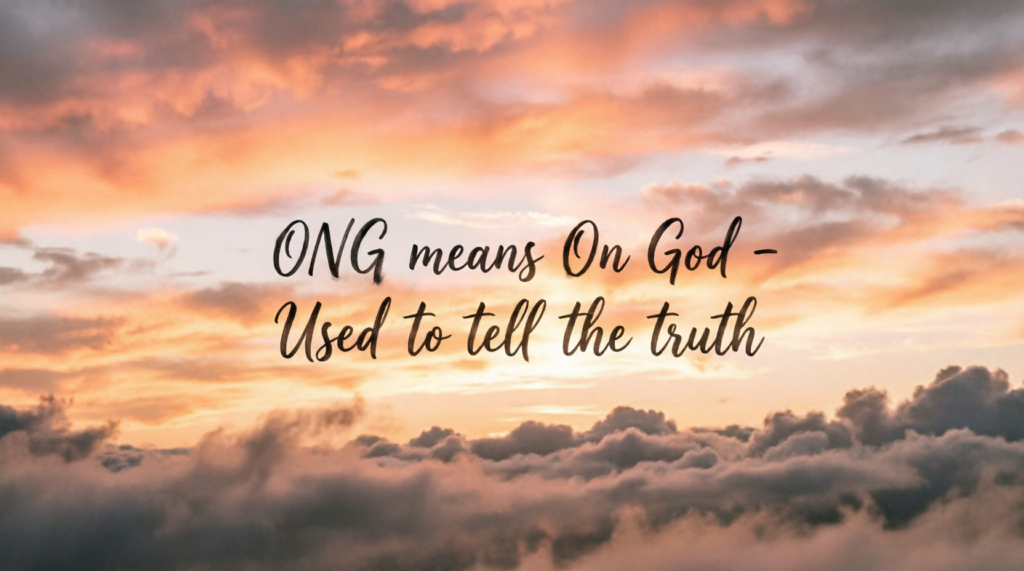
The slang ONG stands for “on God.” It is an internet expression used to emphasize honesty, truth, or strong feelings about something.
In simple words, when someone says “ONG,” they mean:
“I swear this is true” or “I’m being completely honest.”
It is not an acronym in a formal sense, but more of a shortened slang version of a phrase. It comes from modern internet and street language, where “on God” is used to stress sincerity.
Everyday Meaning
In daily texting, ONG is used like this:
- To prove something is true
- To show strong agreement
- To emphasize emotions like shock, anger, or excitement
For example:
- “That movie was amazing ONG”
- “I didn’t do it ONG”
It adds intensity to the sentence, making it sound more emotional or serious.
Where People Use ONG Slang
ONG is widely used across social media platforms, especially where short and fast communication is common.
TikTok
On TikTok, ONG is used in captions, comments, and reactions.
- Users say it to emphasize relatable or funny content
- Often appears in viral trends
Example:
- “This is the funniest video ONG 😂”
Snapchat
On Snapchat, ONG is common in private chats and streak conversations.
- Used for casual promises or reactions
- Often added at the end of sentences
Example:
- “I’m coming now ONG”
On Instagram, it appears in comments and DMs.
- Used under reels or memes
- Shows strong agreement or hype
Example:
- “This outfit is fire ONG”
In WhatsApp chats, ONG is used between friends.
- Used for emotional emphasis
- Often used in arguments or jokes
Example:
- “I didn’t tell anyone ONG”
SMS Texting
Even in basic texting, ONG is used by younger users.
- Shortens emotional expressions
- Makes messages feel more natural and expressive
Real Chat Examples
Here are 10 real-life style conversations showing how ONG is used naturally:
Example 1
A: Did you eat my fries?
B: No ONG I didn’t touch them
Example 2
A: That test was so hard
B: ONG I thought I was going to fail
Example 3
A: You coming to the party?
B: ONG I’ll be there at 8
Example 4
A: That movie was boring
B: ONG I almost slept halfway
Example 5
A: You saw her new phone?
B: ONG it’s actually wild good
Example 6
A: I think he lied
B: ONG I don’t trust him either
Example 7
A: That joke was funny
B: ONG I can’t stop laughing
Example 8
A: You finished homework?
B: ONG I did it last night
Example 9
A: That game was intense
B: ONG my heart was racing
Example 10
A: You like this song?
B: ONG it’s on repeat for me
How to Reply When Someone Says “ONG”
When someone uses ONG in a conversation, your reply depends on tone and context.
Funny Replies
- “Stop swearing on God like that 😂”
- “ONG or cap? Be honest!”
- “You better not be lying ONG!”
Casual Replies
- “I believe you”
- “Okay got it”
- “Makes sense”
Friendly Replies
- “I trust you ONG”
- “Haha okay okay”
- “That’s fair”
Neutral Replies
- “Alright”
- “Noted”
- “Understood”
The best reply depends on whether the conversation is serious or joking.
Is ONG Rude or Offensive?
ONG is not rude or offensive in most situations.
It is simply slang used for emphasis. However, there are a few things to consider:
Is it rude?
No, it is not rude by itself. It is commonly used among friends and online communities.
Is it safe to use?
Yes, it is safe in casual conversations, especially on social media.
School or work use
- In school chats: Usually okay among friends
- In formal writing: Not appropriate
- In workplace messages: Better to avoid
So while it is harmless slang, it is still informal and should not be used in professional communication.
Who Uses This Term?
ONG is mostly used by younger internet users.
Age Groups
- Teenagers (13–19) – most common users
- Young adults (20–30) – also frequent users
- Older users – less common
Gen Z Usage
Gen Z popularized ONG through TikTok and meme culture. It is part of fast, expressive internet language.
Platforms
- TikTok (very high usage)
- Snapchat (high usage)
- Instagram (moderate usage)
- WhatsApp (casual usage)
- Discord and gaming chats (also common)
Frequency
ONG appears often in:
- memes
- viral videos
- reaction comments
- casual texting
It is not rare slang—it is widely recognized online.
Origin of the Term
The phrase “on God” originally comes from American-American Vernacular English (AAVE), where it is used to strongly emphasize truth.
Over time, internet culture shortened it into ONG, making it faster to type.
Internet Influence
- TikTok played a big role in spreading it
- Meme culture helped make it viral
- Rap music and online slang also influenced usage
Is the origin clear?
Yes, the phrase “on God” has clear cultural roots, but the exact moment “ONG” became popular is tied to internet evolution rather than one specific event.
Comparison Table
| Term | Meaning | Type | Usage | Popularity |
|---|---|---|---|---|
| ONG | On God (I swear/seriously) | Slang abbreviation | Emphasis in messages | Very High |
| IDK | I don’t know | Acronym | Uncertainty | Very High |
| IDC | I don’t care | Acronym | Indifference | High |
| IMO | In my opinion | Acronym | Personal opinion | High |
| BRB | Be right back | Acronym | Temporary absence | Medium |
Real-World Usage Example
Imagine you’re sitting with friends at school, and someone asks if the cafeteria food was good today.
One friend says:
- “ONG it was actually better than yesterday.”
Everyone immediately understands they are strongly agreeing that the food improved. No one needs a long explanation—ONG adds emotion and emphasis in just three letters.
Full Guide to Usage Context Online Culture
ONG slang is a short internet expression that means on God, used to strongly emphasize honesty or truth in a message. It appears mainly and everyday texting among younger users.
People search for it because they often see ONG in casual conversations and don’t immediately understand the emotional tone behind it.
This guide breaks it down in a deeper way, focusing on how it behaves in real digital communication.
ONG as a Digital Emotion Marker
ONG is not just a word—it works like an emotion booster in text.
Instead of typing long explanations like:
- “I’m really serious about this”
- “I swear I’m telling the truth”
People shorten it to ONG.
What it does in conversation:
- Adds urgency to statements
- Shows emotional honesty
- Makes messages feel more intense
- Replaces longer phrases
Example:
- “I was so tired ONG I couldn’t move”
Here, ONG strengthens the feeling of exhaustion.
ONG in Casual vs Serious Tone
The meaning of ONG changes slightly depending on tone.
Casual Use
Used in jokes, memes, or light conversations:
- “That burger was huge ONG 😂”
Serious Use
Used when someone wants to sound truthful or defend themselves:
- “I didn’t leak the secret ONG”
Emotional Use
Used during strong feelings like excitement or shock:
- “ONG this is unbelievable”
So ONG adapts depending on mood rather than having a fixed meaning.
ONG in Internet Slang Evolution
ONG belongs to a bigger trend of compressed emotional slang.
Internet language is moving toward:
- Short forms (ONG, IDK, FR)
- Fast emotional signals
- Meme-based expressions
ONG evolved because users wanted:
- Faster typing
- Stronger emotional impact
- Social media-friendly language
It’s part of a digital shift where grammar matters less than expression speed.
ONG vs Similar Slang Expressions
ONG is often compared with other slang terms that also show emphasis or honesty.
FR (For Real)
- Means agreement or seriousness
- Example: “That was wild FR”
No Cap
- Means “no lie”
- Example: “That’s the best movie no cap”
Ong vs FR vs No Cap
- ONG = emotional truth emphasis
- FR = agreement or confirmation
- No Cap = honesty without exaggeration
ONG feels more emotional, while “no cap” feels more factual.
Psychological Reason Behind Using ONG
People don’t just use ONG randomly—it serves a communication purpose.
Why people use it:
- To sound more believable
- To express strong feelings quickly
- To build trust in casual chats
- To match online group language
It also helps reduce misunderstandings in text where tone is unclear.
Example:
- Without ONG: “I didn’t do it”
- With ONG: “I didn’t do it ONG”
The second version feels more emotionally convincing.
ONG in Meme Culture
ONG is heavily used in memes because it adds dramatic humor.
Memes often exaggerate situations, and ONG helps enhance that exaggeration.
Meme-style usage:
- “Me studying for 5 minutes ONG I deserve a degree”
- “ONG this is the worst day of my life (it’s just Monday)”
It makes jokes feel more expressive and relatable.
ONG in Online Arguments
ONG also appears in digital arguments or debates.
How it is used:
- To defend a statement
- To insist truthfulness
- To strengthen claims
Example:
- “I never said that ONG stop lying”
However, in arguments it can sound intense or defensive, depending on context.
ONG in Gaming Chats
Gamers use ONG in fast-paced communication.
Typical usage:
- Reacting to gameplay moments
- Confirming actions
- Expressing frustration or excitement
Example:
- “ONG that shot was wild ”
- “I lagged ONG that cost us the match”
In gaming, ONG helps express quick reactions without long typing.
Regional and Cultural Spread of ONG
ONG is not limited to one country or culture.
Where it is popular:
- USA (origin influence)
- UK youth communities
- South Asian TikTok users
- Global gaming communities
The spread is driven mainly by:
- TikTok trends
- Music influence
- Meme sharing culture
It is now a global slang term understood by most internet users.
ONG in Voice vs Text Communication
ONG behaves differently depending on how it is used.
In Text:
- Short and symbolic
- Adds emotional tone
In Voice (spoken slang):
People say “on God” instead of ONG:
- “On God, I didn’t do it”
Difference:
- ONG = typed slang
- On God = spoken expression
Both mean the same thing but fit different communication styles.
Misunderstandings About ONG
Some people misinterpret ONG because it looks like an acronym.
Common misunderstandings:
- Thinking it is a technical abbreviation
- Confusing it with gaming terms
- Assuming it has formal meaning
Reality:
- It is informal slang
- Not used in official writing
- Purely internet-based expression
Understanding context is key to interpreting it correctly.
How ONG Changes Sentence Meaning
ONG can slightly change the emotional weight of a sentence.
Without ONG:
- “That movie was good”
With ONG:
- “That movie was good ONG”
Difference:
- First = normal opinion
- Second = strong emotional approval
It turns simple statements into expressive reactions.
Why ONG Became So Popular
Several reasons explain its rise:
- Short and easy to type
- Fits meme culture
- Popular on TikTok
- Used by influencers and creators
- Feels natural in casual speech
Its simplicity is the main reason it spread quickly.
ONG in Future Internet Language
Slang like ONG shows how language is evolving online.
Future trends:
- Even shorter slang
- More emotion-based expressions
- Heavy meme influence
- Less formal grammar online
ONG may remain popular or evolve into newer versions, but the concept of emotional shorthand will continue.
Frequently Asked Questions
What does ONG mean in text messages?
ONG means “on God,” used to show strong honesty or emphasize truth in a message.
What does ONG mean on TikTok?
On TikTok, ONG is used in captions and comments to react strongly or confirm something is true.
Is ONG slang?
Yes, ONG is internet slang derived from the phrase “on God.”
Is ONG rude or offensive?
No, it is not offensive. It is casual slang used for emphasis.
How should you reply to ONG?
You can reply casually like “okay,” “I believe you,” or jokingly like “ONG or cap?”
Conclusion
ONG is a simple internet slang term that means on God. People use it to emphasize honesty emotion or strong reactions in everyday chats.
It is mostly seen on TikTok, Snapchat, Instagram and casual texting among friends. While it is not rude it is still informal and should not be used in professional or formal settings.
Understanding slang like ONG helps you keep up with modern online conversations and avoid confusion when you see it in messages or social media posts.
Discover more post:
| https://meanguid.com/smh-mean-in-text/ |
| https://meanguid.com/wy-meaning-in-text/ |
| https://meanguid.com/what-does-hm-mean-in-slang/ |