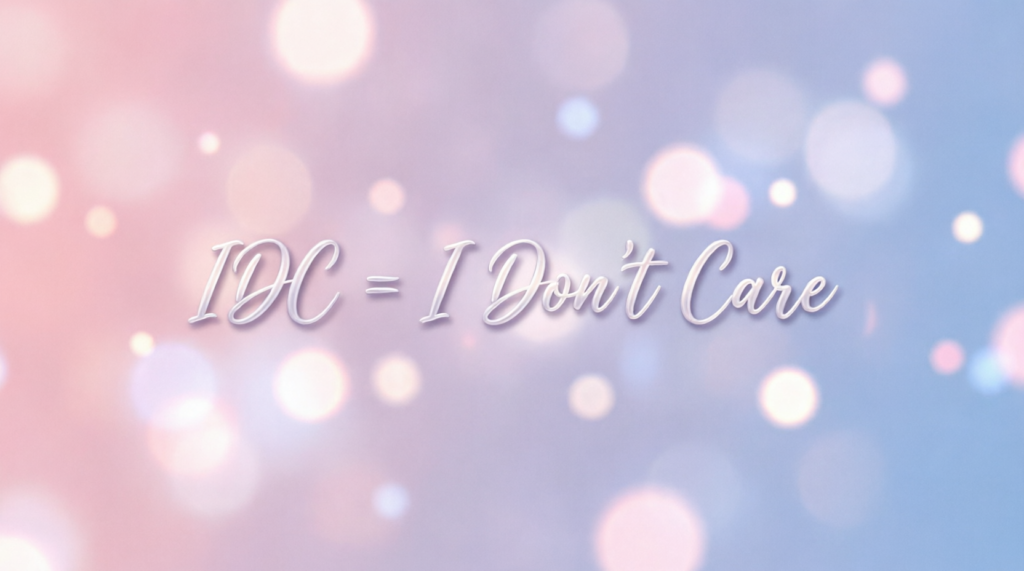
IDC is a popular internet slang term that means I don’t care. You’ll see it in texting TikTok comments Snapchat chats, and Instagram DMs. People use it when they want to show indifference or disinterest in a situation.
It’s one of the most common acronyms in online conversations especially among teens and Gen Z users. Many people search for it because they see it in messages but don’t fully understand the tone behind it.
Sometimes it can sound casual and other times it can feel a bit rude depending on how it’s used. That’s why understanding context is important.
In this guide, we’ll break down what IDC really means,where it’s used how to respond to it and whether it’s appropriate in different situations.
what does idc mean in text Meaning in Text
“IDC” is an abbreviation for the phrase “I don’t care is used in casual digital communication to show that someone is not interested in something or does not have a strong opinion about it.
is not formal language. belongs to internet slang and texting shorthand, similar to words like “LOL” or “BRB.”
In everyday chat, “IDC” can mean different things depending on tone:
- True indifference: the person genuinely doesn’t care
- Casual response: the person is neutral and okay with anything
- Emotional distance: the person is annoyed or shutting down the conversation
So even though the meaning is simple, the emotional tone can change a lot based on context.
Where People Use what does idc mean in text
People use “IDC” across almost all social media and messaging platforms. It’s short, fast, and easy to type, which makes it perfect for online conversations.
TikTok
On TikTok, “IDC” often appears in comments or captions. Users might write it when reacting to trends, drama, or opinions.
Example:
- “IDC what anyone says, this song is fire.”
Snapchat
On Snapchat, it’s commonly used in quick chats with friends. The tone can be casual or slightly emotional depending on the situation.
Example:
- “IDC, pick whatever you want for dinner.”
On Instagram, you might see it in DMs or comment sections. It can be used jokingly or seriously.
Example:
- “IDC if it’s old, this photo is still good.”
On WhatsApp, people use it in personal conversations, especially when deciding plans or responding quickly.
Example:
- “IDC, we can go wherever you want.”
SMS (Text Messaging)
In regular SMS texting, “IDC” is used the same way—short responses when someone doesn’t want to explain too much.
Example:
- “IDC anymore, just do what you think is best.”
Real Chat Examples
Here are 10 realistic texting conversations to show how “IDC” is used in real life:
1.
A: What movie should we watch?
B: IDC, you choose
2.
A: Do you want pizza or burgers?
B: IDC, both are fine
3.
A: She unfollowed you again
B: IDC honestly
4.
A: Are you mad?
B: IDC, I’m just tired
5.
A: This new trend is wild
B: IDC, I don’t use TikTok much
6.
A: Should I wear the black shirt or white?
B: IDC, both look good
7.
A: He said you were wrong
B: IDC what he thinks
8.
A: Let’s go out tonight
B: IDC, I’m okay staying home too
9.
A: Did you see her post?
B: IDC, I’m not checking her profile
10.
A: You okay with the plan?
B: IDC, just go ahead
These examples show how flexible the term is in everyday conversations.
How to Reply When Someone Says “IDC”
When someone says “IDC,” your reply depends on their tone. It can be neutral, funny, or even slightly emotional.
Funny Replies
- “Wow, emotional support level: zero 😂”
- “IDC? That’s your final form?”
- “Okay chill, robot mode activated 🤖”
Casual Replies
- “Alright, I’ll decide then”
- “Okay, I got you”
- “No problem, I’ll pick”
Friendly Replies
- “Alright, I’ll choose something you’ll like”
- “Got it, I’ll decide for both of us”
- “Okay, I’ll make it easy for you”
Neutral Replies
- “Okay”
- “Understood”
- “Alright, sounds good”
The key is not to overreact. Most of the time, “IDC” is just a quick response, not a serious emotional statement.
Is what does idc mean in text Rude or Offensive?
“IDC” is not always rude, but it can sound rude depending on context and tone.
When it is NOT rude:
- When used casually with friends
- When deciding simple things
- When used in a relaxed conversation
When it CAN sound rude:
- When someone is upset
- When used during an argument
- When it replaces a thoughtful response
Is it safe to use?
Yes, it is generally safe to use in casual online chats.
Is it appropriate at school or work?
- School: Yes, in casual student chats
- Work: Not recommended in professional communication
In formal situations, it’s better to write full sentences like “I don’t have a preference.”
Who Uses This Term?
“IDC” is mostly used by younger internet users, but it’s not limited to any one age group.
Age groups:
- Teens (13–19): Very common
- Young adults (20–30): Frequently used
- Older users: Less common but still understood
Gen Z usage:
Gen Z uses “IDC” regularly in texting culture. It’s part of fast, minimal communication style.
Platforms:
- TikTok (very high usage)
- Snapchat (very high usage)
- Instagram (moderate to high usage)
- WhatsApp (high usage in private chats)
- SMS (still used, but declining)
How often it appears online:
It appears constantly in comments, messages, and captions because it is short and expressive.
Origin of the Term
“IDC” comes from early internet chat culture where people started shortening common phrases to type faster.
It evolved from:
- Full phrase: “I don’t care”
- Texting shorthand: “IDC”
Internet forums, MSN Messenger, early SMS texting, and later social media helped popularize it.
The exact origin is not tied to one platform, but it became widely recognized as texting culture grew in the 2000s and 2010s.
Today, it’s part of global internet slang used across multiple platforms.
Comparison Table
| Term | Meaning | Type | Usage | Popularity |
|---|---|---|---|---|
| IDC | I don’t care | Slang / Acronym | Casual replies, indifference | Very High |
| IDK | I don’t know | Slang / Acronym | Uncertainty or lack of knowledge | Very High |
| IMO | In my opinion | Acronym | Sharing opinions | High |
| BRB | Be right back | Acronym | Temporary absence in chat | Medium-High |
| IDC vs others | Shows indifference | Slang | Quick emotional response | Very High |
This table shows how IDC fits into the wider world of internet abbreviations.
Real-World Usage Example
Imagine two friends planning a weekend hangout.
One friend is excited and keeps asking what to do, where to go, and what time to meet. The other friend is tired and not interested in making decisions.
Instead of typing long replies, they simply say “IDC, you choose.”
This keeps the conversation short and avoids unnecessary back-and-forth.
It’s quick, simple, and commonly used in real-life texting situations.
Emotional Tone Behind “IDC” in Conversations
Even though “IDC” looks simple, the emotional meaning can change a lot depending on how it’s used.
Sometimes it shows real disinterest, like someone genuinely doesn’t care about the topic. Other times, it hides frustration, tiredness, or emotional withdrawal.
For example, in an argument, “IDC” can feel like the person is closing the conversation. But in a casual chat, it might just mean “I’m flexible, you decide.”
Tone matters more than the word itself.
Different Meanings Based on Context
“IDC” is not a fixed emotional expression—it shifts depending on the situation.
- In friendly chats → “I’m okay with anything”
- In arguments → “I’m done discussing this”
- In decision-making → “I have no preference”
- In sarcasm → “I actually do care, but I won’t show it”
This flexibility is why misunderstandings often happen online.
IDC vs Full Sentence Communication
People often compare “IDC” with saying the full sentence “I don’t care.”
Using the abbreviation feels:
- Faster
- More casual
- More emotionally distant
Using the full sentence feels:
- More polite
- More clear
- More respectful in serious talks
That’s why professionals avoid abbreviations like IDC in formal communication.
Why People Prefer Saying “IDC” Instead of Explaining
Most people don’t use “IDC” just for laziness—it also helps avoid emotional effort.
Common reasons include:
- Not wanting to argue
- Feeling tired of explaining
- Avoiding conflict
- Wanting quick replies
- Keeping conversations short
In digital communication, speed often matters more than detail.
Misunderstandings Caused by “IDC”
One of the biggest issues with “IDC” is misinterpretation.
For example:
- One person means “I’m fine with anything”
- The other person hears “you don’t matter”
This mismatch can lead to:
- Arguments
- Hurt feelings
- Silent treatment
- Overthinking in chats
That’s why tone and relationship context are very important.
IDC in Digital Communication Style Trends
Modern texting culture has moved toward short-form emotional language.
“IDC” fits into a larger trend of:
- Acronyms replacing full sentences
- Minimal typing
- Fast emotional expression
- Emoji-based communication
It reflects how online conversations are becoming more efficient but sometimes less expressive.
IDC in Friendships vs Relationships
The meaning of “IDC” changes depending on relationship closeness.
In friendships:
It usually means casual flexibility—like letting friends decide plans.
In romantic relationships:
It can sometimes signal emotional distance or lack of interest, especially if overused.
That’s why frequency matters more than the word itself.
Signs Someone Might Not “Actually” Mean IDC
Sometimes people say “IDC” but don’t truly mean it.
You can often tell by:
- Repeated follow-up messages
- Passive-aggressive tone
- Short, delayed replies
- Expecting you to “guess correctly”
In these cases, “IDC” may be more emotional than literal.
Healthy Ways to Replace “IDC” in Conversations
If someone wants clearer communication, they can replace “IDC” with more specific phrases like:
- “I’m okay with either option”
- “You decide, I trust your choice”
- “I don’t have a strong preference”
- “Anything works for me”
IDC in Online Arguments and Conflicts
In heated conversations, “IDC” is often used as a conversation stopper rather than a real expression of indifference.
Instead of continuing a disagreement, one person may type “IDC” to avoid escalation. This can signal emotional shutdown, where the person no longer wants to debate or explain their position.
In this context, it doesn’t always mean lack of care—it can mean “I’m done discussing this.”
That’s why it often changes the direction of online arguments very quickly.
Psychological Side of Using “IDC”
From a communication perspective, “IDC” can reflect different mental states.
Some people use it when they feel:
- overwhelmed
- emotionally drained
- uninterested in conflict
- detached from the topic
It becomes a shortcut for emotional protection, allowing someone to step back from pressure without explaining too much.
In short, it’s not always about the topic—it can be about how the person feels internally.
IDC in Group Chats and Social Dynamics
In group chats, “IDC” plays a different role compared to one-on-one conversations.
It is often used when:
- decisions are being made
- plans are being discussed
- no one wants responsibility for choosing
However, repeated use of “IDC” in groups can create frustration, because it shifts decision-making pressure onto others.
This can sometimes lead to uneven participation in conversations.
IDC as a Passive Communication Style
“IDC” is part of a broader communication style called passive expression.
Instead of directly saying what they want, people using IDC may:
- avoid commitment
- stay neutral on purpose
- let others take control
- reduce emotional involvement
This style is common in fast digital communication, where people prefer simplicity over detailed responses.
Differences Between IDC and Similar Expressions
Not all “short replies” mean the same thing.
- “IDC” → emotional neutrality or withdrawal
- “Whatever” → slight irritation or dismissal
- “Up to you” → polite decision transfer
- “Fine” → acceptance (sometimes reluctant)
Even though they look similar, each one carries a different emotional weight in conversation.
Cultural Impact of “IDC” in Internet Language
“IDC” reflects how modern internet culture has changed communication.
Instead of full emotional explanations, people now prefer:
- short acronyms
- fast reactions
- minimal typing effort
This shift shows how digital platforms have influenced how people express feelings—less detail, more speed.
It’s part of a larger trend where language adapts to screen-based communication.
Situations Where Using “IDC” Can Be Misread
Even when someone means it casually, “IDC” can be misunderstood in certain situations:
- when discussing serious topics
- during emotional conversations
- in planning something important
- when the other person is seeking reassurance
In these cases, it may come across as dismissive even if no offense is intended.
Why “IDC” Is Popular in Fast Messaging Culture
The popularity of “IDC” is strongly linked to modern communication habits.
People prefer it because:
- it saves time
- it avoids long explanations
- it keeps conversations flowing quickly
- it reduces emotional effort
It fits perfectly into today’s “quick reply” culture on apps like Snapchat, WhatsApp, and TikTok.
Emotional Intelligence and Use of “IDC”
Using “IDC” effectively depends on emotional awareness.
In some situations, it is better replaced with clearer expressions to avoid confusion. People with higher communication awareness often adjust how they respond depending on the listener.
This helps maintain smoother relationships and reduces misunderstandings in digital chats.
IDC as a Micro-Expression in Digital Language
“IDC” works like a micro-expression in text form—a very short phrase that carries emotion without full explanation.
Instead of writing a full emotional sentence, people compress their attitude into three letters. This makes communication faster but also less expressive in detail.
It shows how modern texting prefers compressed emotion over full explanation.
Role of IDC in Decision Fatigue
Many people use “IDC” when they are mentally tired of making choices.
This is common in situations like:
- picking food
- choosing plans
- deciding time or place
Instead of thinking more, the person uses “IDC” to transfer decision responsibility to someone else.
It’s less about indifference and more about mental overload.
IDC in Digital Etiquette and Communication Balance
In online communication, “IDC” can sometimes be seen as poor etiquette if overused.
Healthy conversations usually involve balance—both people contributing ideas. But when one person constantly replies with “IDC,” it can:
- slow down decision-making
- frustrate the other person
- create imbalance in conversation effort
So etiquette depends on frequency and situation.
How Tone Markers Change the Meaning of IDC
In text messages, “IDC” doesn’t stand alone. Its meaning changes depending on tone markers like:
- emojis 😐😂
- punctuation !!! or …
- timing of reply
- surrounding words
For example:
- “IDC 🙂” feels calm
- “IDC.” feels cold
- “IDC!!!” feels annoyed
So the same abbreviation can carry completely different meanings.
IDC in Minimalist Communication Culture
“IDC” is part of a larger movement toward minimalist texting.
Instead of long emotional messages, people prefer:
- acronyms
- one-word replies
- emojis
- short reactions
This reflects how mobile-first communication encourages speed over depth.
IDC as a Boundary-Setting Tool
Sometimes “IDC” is not about disinterest—it’s used as a way to set emotional boundaries.
A person may use it when:
- they don’t want to be involved in conflict
- they want to avoid pressure
- they are stepping away from responsibility
In this sense, it acts like a soft way of saying: “I’m not engaging further.”
IDC in Fast-Paced Social Media Interaction
On platforms like TikTok and Instagram, “IDC” is often used in:
- quick comments
- reactions to trends
- short opinion posts
Because social media rewards speed, users prefer short reactions instead of detailed explanations.
It helps them participate in conversations without spending too much time typing.
IDC and Perceived Emotional Distance
Even when meant casually, “IDC” can create a feeling of emotional distance.
This happens because:
- it removes explanation
- it avoids emotional detail
- it ends conversation quickly
As a result, the receiver may feel less connected or slightly dismissed, depending on context.
IDC in Group Decision Pressure Situations
In group settings, “IDC” often appears when people are trying to avoid responsibility.
However, repeated use can lead to:
- one person doing all decision-making
- frustration within the group
- imbalance in participation
This makes it more of a social dynamic issue than just slang.
IDC as a Reflection of Internet Communication Evolution
“IDC” shows how language has evolved in the digital era.
Older communication styles favored full sentences. Modern texting favors:
- speed
- brevity
- emotional shortcuts
It reflects how internet culture reshapes language into more efficient but compact forms.
IDC and Personality Expression in Texting
Interestingly, frequent use of “IDC” can sometimes reflect communication style or personality traits such as:
- introversion in digital spaces
- low interest in conflict
- preference for simplicity
- avoidance of long discussions
Frequently Asked Questions
What does what does idc mean in text mean in text messages?
It means “I don’t care” and is used to show indifference or lack of preference.
What does what does idc mean in text mean on TikTok?
On TikTok, it is used in comments or captions to express opinions or reactions quickly.
Is what does idc mean in text slang?
Yes, it is internet slang and a common texting abbreviation.
Is what does idc mean in text rude or offensive?
It can sound rude depending on tone, but it is usually neutral in casual chats.
How should you reply to what does idc mean in text?
You can respond casually, humorously, or just make a decision for the conversation.
Conclusion:
IDC simply means I don’t care and it is widely used in texting and social media. People use it to show indifference make quick decisions or avoid long explanations.
It appears on platforms like TikTokSnapchat Instagram WhatsApp and SMS chats. While it is mostly harmless, it can sometimes sound rude depending on context.
It’s best used in casual conversations and avoided in formal or professional settings where clear communication is needed.
Discover more post:
| https://meanguid.com/iykwim-mean-in-text/ |
| https://meanguid.com/what-do-hm-mean-in-text/ |
| https://meanguid.com/what-does-yg-mean-in-text/ |